Fill & buffer
Incoming wastewater is received and buffered so short-term flow peaks do not immediately disrupt treatment.
How it works
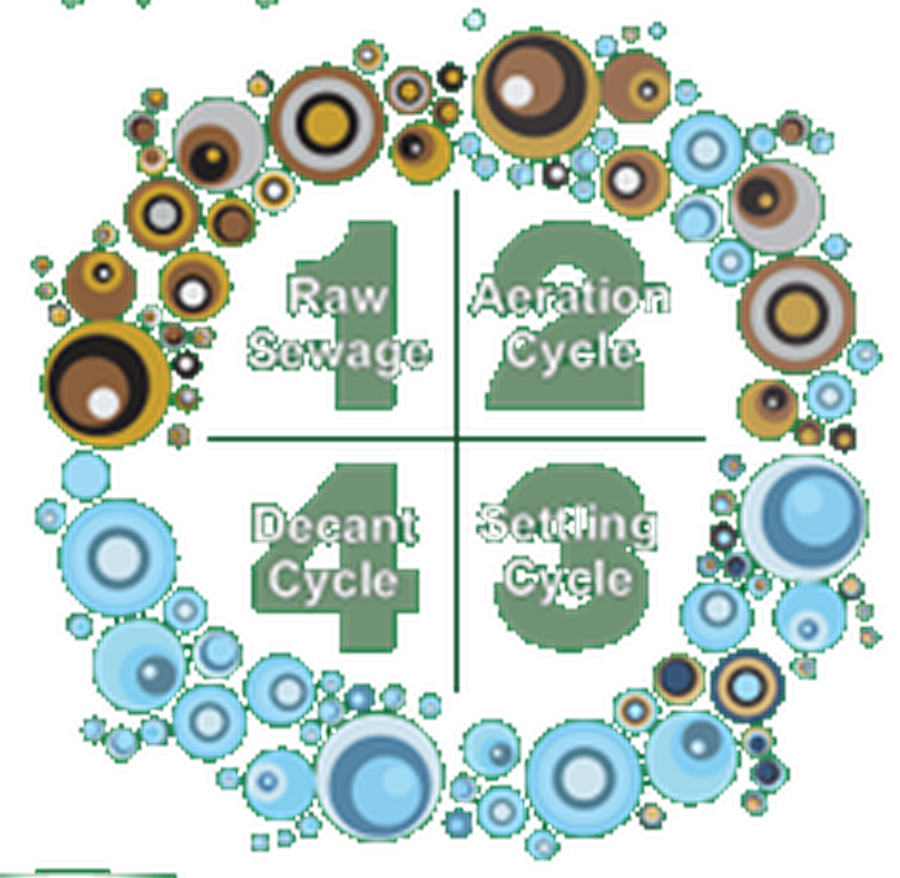
The core treatment technology uses a repeated buffering, aeration, settling and decanting cycle. This allows wastewater to be treated in a compact footprint without relying on membranes or a separate conventional septic compartment.
Plain-language overview · Detailed engineering follows site assessment.
The treatment cycle
The control cycle separates the main treatment functions by time, allowing the same tank volume to perform multiple jobs.
Incoming wastewater is received and buffered so short-term flow peaks do not immediately disrupt treatment.
Air supports the biological population that consumes organic material and reduces wastewater strength.
Aeration pauses, allowing suspended biological solids to settle and leaving clearer treated water above.
A floating decanter draws treated water from the clear upper zone for approved dispersal or further treatment.
Inside the system
A typical RP10 arrangement uses a 5,000-litre treatment tank with an operating buffer of approximately 1,500 litres. Under its standard operating cycle, the blower runs for about 12 hours in each 24-hour period rather than aerating continuously.
Combines biological treatment, settling and decanting functions in one vessel.
Deliver oxygen and mixing during the programmed treatment period.
Sequences the operating phases and supports repeatable performance.
Draws from the clearer zone below the surface and above settled solids.
From inlet to reuse
Reliable outcomes depend on the complete wastewater pathway, not just the treatment tank.
Keep unsuitable oils, chemicals, stormwater and foreign material out of the wastewater stream.
Size and grade pipework correctly and manage grease or commercial waste before treatment where needed.
Match plant capacity and cycle settings to real hydraulic and organic loading.
Select an approved irrigation, subsurface disposal or higher-treatment arrangement for the site.
What changes by site
✓ Number of users and occupancy pattern
✓ Wastewater sources and expected strength
✓ Soil, slope, groundwater and flood risk
✓ Power supply and backup requirements
✓ Discharge, irrigation or reuse objective
✓ Local approvals and monitoring requirements
✓ Operator skill and service access
✓ Planned future expansion
Technical discussions welcome
AfriKleen can help turn user numbers, flow estimates and site constraints into a clear basis for design.
Discuss a project